Over 35% of aerospace and energy parts across Texas now rely on CNC milling. That shift has turned Houston an important center in industrial machining. Regional fabricators and technical teams often look for local machining partners to shorten turnaround times and protect quality on high-value assemblies.
Machining Services Houston
This article breaks down Houston CNC milling and its manufacturing advantages. It explains how Houston machining services achieve tight tolerances for many industries, from energy production to medical devices. If you require a machine shop Houston partner for a single test part or high-volume manufacturing, Houston offers a range of options. Local facilities operate 3-, 4-, and 5-axis mills, live-tool turning centers, and EDM support.
Lowrance Machine’s team is an experienced supplier of close-tolerance machining in the area. Contact the team through www.lowrancemachine.com to review your technical needs, material choices, and scheduling with a machining partner experienced in demanding prototype-to-production programs.
Important Points
- Houston CNC milling is important for local aerospace, energy, and medical manufacturing networks.
- Machining services Houston include high-capability three-, four-, and five-axis milling plus wire EDM, probe EDM, and live-tool turning.
- Working with a nearby Houston CNC machine shop can reduce delays and simplify project coordination.
- Lowrance Machine’s operation handles small-run and scalable production requirements with inspection-focused quality controls.
- Evaluate shops on available machinery, materials expertise, and capacity for scalable production.
Why Houston Has Become A Hub For Precision CNC Milling And Industrial Machining
The mix of industries in Houston ensure a constant need for accurate components. Businesses across energy, petrochemical, aerospace, and medical markets depend on parts with exact fits and documented history. The local need creates opportunities for Houston machining companies to produce first articles, assemblies, and repeat-run components.
Thousands of manufacturers in the Houston area form a deep manufacturing network. Machine shops can coordinate with regional support shops for coatings, heat treat, and inspection work. This network shortens delivery times, allowing rapid design iterations for complex components.
Houston is a key hub for energy-field hardware manufacturing, with strong connections to pipeline infrastructure and the Port of Houston. Houston’s shipping and freight strengths make easier the delivery of oversized and heavy parts to domestic and international buyers. That logistical advantage serves both prototype and large-scale production needs.
The Johnson Space Center and a thriving aerospace cluster of more than 150 companies drive demand for flight hardware and test fixtures. CNC Milling specialists in Houston find consistent work in creating fixtures, aerospace brackets, and medical devices. These projects require precise surface finishes and complete inspection records.
Local infrastructure supports large-scale machining services in Houston. Being close to suppliers of raw materials, toolmakers, and inspection labs reduces transport times. That speed is critical for oilfield, gas, and biomedical sectors, where part qualification is swift.
CNC Milling Houston
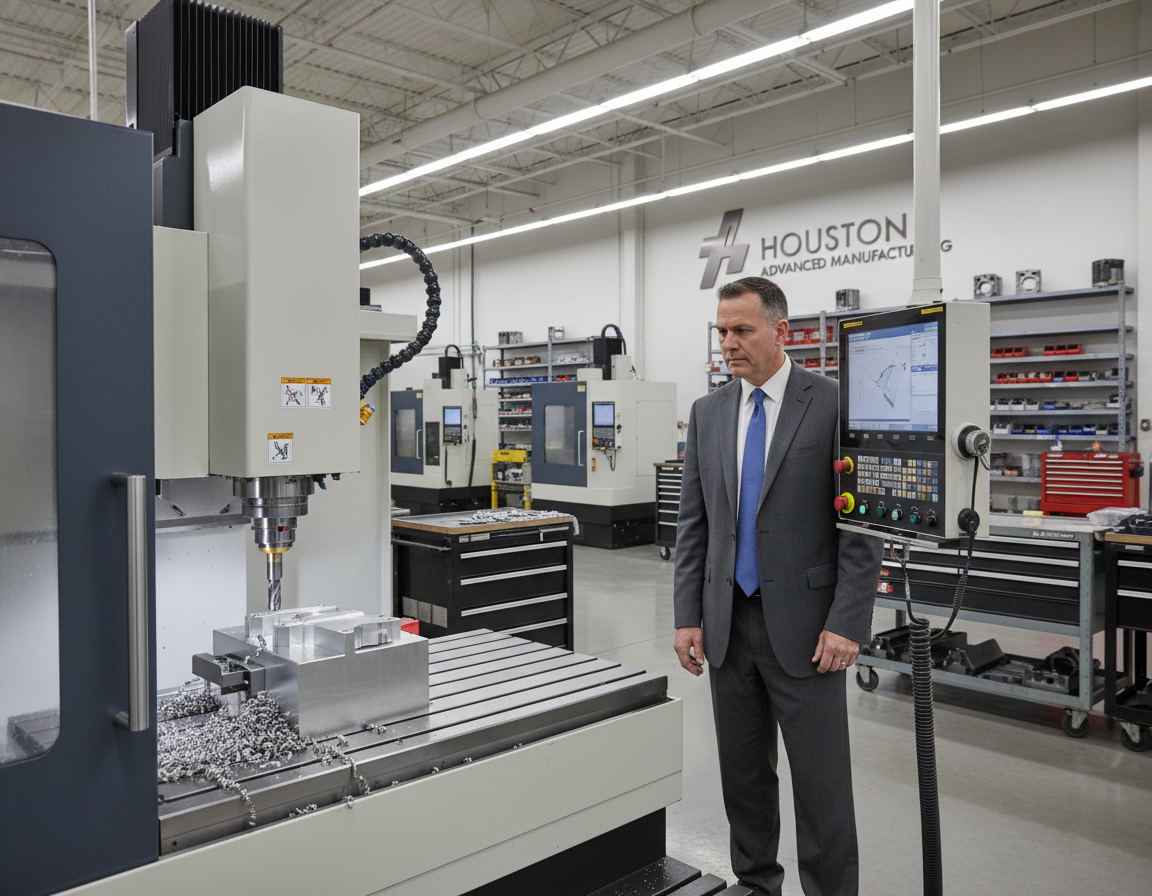
CNC milling converts CAD models into close-tolerance alloy and polymer parts. It uses computer-controlled 3-, 4-, and 5-axis mills. Houston shops employ high-efficiency cutting paths and high-RPM spindles to achieve close tolerances with clean finishes. Those capabilities support aerospace, medical, energy, and subsea components that require precision and fine detail.
Top-tier facilities integrate multi-axis mills with rotary tables. The combined configuration makes possible complex contours to be produced with fewer setups. It reduces changeovers and compresses turnaround for prototypes and production runs. Live tooling and high-speed machining help machinists produce detailed features and small radii with repeatable accuracy.
Definition And Capabilities Of CNC Milling
CNC milling relies on programmed tool movement to machine stock with precision end mills and cutters. Simultaneous axis movement enables combined tool movement on three to five axes. This supports the creation of compound angles, undercuts, and complex pockets in one operation. Modern cutting paths like high-efficiency roughing and adaptive clearing enhance chip control and cutter life.
Many Houston precision shops hold tolerances aligned with aerospace and medical standards. Close-tolerance machining may include thermal compensation, rigid spindles, and machine probing for real-time dimensional verification. This equipment ensure parts achieve consistent accuracy across production across production lots.
Equipment And Capacity Found In Houston Shops
Local CNC machine shop Houston operations use machines from major machine-tool manufacturers such as Haas, DMG MORI, and Mazak. The DMG MORI NVX and NLVX series mills handle 4-axis work with rotary tables for mid-size and larger components. Larger machining-center investments help shops move from first article to repeat manufacturing.
Large-format machining centers machine heavy or oversized workpieces for pressure-rated housings and offshore hardware. Shops emphasize machines that hold accuracy on large parts, using robust platens and gantry designs. This capacity reduces the need to outsource large parts and keeps quality control local.
| Machining Capability | Typical Hardware | Primary Benefit |
|---|---|---|
| 3-, 4-, 5-axis milling | DMG MORI NVX, Mazak VARIAXIS | Difficult geometry with fewer setups |
| Oversized-part machining | Bridge-type centers and gantry mills | Accurate machining of oversized parts |
| Live-tool turning and milling | Live-tool lathes and turn/mill centers | Combined mill/turn operations; fewer handoffs |
| High-RPM spindles | High-RPM spindle units | Improved finish with shorter cycles |
| On-machine probing | On-machine measurement and Renishaw probes | Fast checking of key features |
Additional support services in a full-capability machine shop Houston include CNC lathe machining Houston for turned features and secondary operations. Using both turning and milling limits workpiece movement and compresses the complete production cycle.
Selecting a nearby machining partner with multi-axis capability and trusted brands makes demanding tolerances easier to manage and speed up project schedules. Good fixturing, optimized tooling, and modern machine tools create the foundation of strong Houston CNC milling services.
Lowrance Machine Services For Precision Manufacturing
Lowrance Machine supports serving both prototype and production needs, with attention to precision, timely delivery, and documented quality. The company brings a combination of automated CNC work and manual machining skill, supporting short runs, complex parts, and regulated industries. The operation pairs advanced machines with practical machinist experience to meet tight tolerances and schedule demands.
Complete CNC Milling And Machining Services
As a reliable Houston CNC machine shop, the Lowrance Machine team provides CNC milling, turning, and assembly support. The shop handles advanced milling, turn/mill operations, and long-bed turning for long components. EDM services, including wire and probe EDM enable precise internal features that are not always practical with conventional tooling.
Deep-hole gun drilling and BTA drilling cover diameters from 0.25″ up to 3.75″ and deep bores for specialized hole-making. In-house secondary operations include heat treat, plating, powder coat, and paint so finished parts are closer to installation-ready. Those finishing options shorten turnaround and reduce the burden of coordinating outside vendors.
Houston manual machining services are provided for fixtures, jigs, and small production quantities. Experienced machinists handle close fitting, trial assembly, and individual part changes that complement CNC production. This mix of automated and manual processes helps with fast prototypes and easier production ramp-up.
Quality Systems And Certifications
Quality at Lowrance Machine centers on traceability, measurement, and repeatable controls. The shop integrates CMM checks, SPC records, and probe EDM verification to help verify repeatability. Those quality steps help customers in aerospace, medical, and heavy-industry markets that depend on traceable records.
Local shops in Houston commonly point to AS9100D and ISO 9001:2015 to demonstrate their focus on controlled processes. A regional example is Midway Machine of a Houston-area supplier holding aerospace and general quality certifications, which reflects what many customers expect from precision suppliers. Lowrance Machine’s process approach aligns to comparable industry expectations to help satisfy audit and compliance needs.
| Machining Service | Core Capabilities | Practical Benefit |
|---|---|---|
| CNC Milling | three- to five-axis milling, fast spindles, and hardened-material methods | Complex contours, tight tolerances, repeatable runs |
| CNC Turning And Live Tooling | long-bed lathe work, multi-turret machines, and live-tool milling | Reduced setups, efficient small- to medium-volume production |
| Electrical-Discharge Machining | wire EDM plus probe EDM checking for internal geometry | Fine detail, burr-free finishes, hardened steel capability |
| Gun And BTA Drilling | deep-hole drilling from 0.25 inches through 3.75 inches | Consistent deep holes, improved part functionality |
| Manual Machining Services | bench operations, fit-up work, and custom fixtures | Quick turn prototypes, hands-on adjustments |
| Measurement And Quality Assurance | coordinate measurement, SPC, probing, and inspection reports | Traceability for regulated industries, reduced rework |
| Secondary Finishing Support | Heat treat, plating, powder coat, painting, zinc phosphating | Parts ready for assembly, fewer subcontractors |
Working with a supplier that blends complete Houston machining services with disciplined inspection controls shortens delivery time and helps prevent production surprises. Lowrance Machine blends advanced CNC machine shop Houston capability with skilled machining professionals to handle prototypes, production runs, and regulated supply chains.
Houston CNC Machine Shops: Materials And Industries Served
Machine shops in Houston work with a broad selection of metallic materials and specialty plastics. These shops support strict tolerances and harsh environments. By combining manual skills with automated processes, they deliver parts for both heavy industries and precision fields.
Here is a practical overview at common materials and the industries that rely on them.
Range Of Materials Machined
Carbon steels and alloy steels are key for oilfield and energy work, forming valve bodies, pressure housings, and structural parts. Stainless steel is selected because of its resistance to corrosion and easy cleaning.
Copper, bronze, brass, and aluminum are machined into components needing conductivity, weight savings, and practical strength. Nickel alloys handle hot, corrosive, and demanding service environments in subsea and refinery settings.
Engineering plastics like PEEK, Delrin, and UHMW are selected for parts needing wear control, reduced friction, and chemical resistance. These are essential in assemblies requiring weight reduction, chemical resistance, or smooth motion. Manual machining in Houston makes possible careful hand finishing on soft or specialized materials, supporting the last-stage fit and tactile quality.
Major Industries And Application Examples
Oil and gas companies order subsea hardware, valve bodies, and pressure housings. Those components require heavy-duty machining, straightness control, and detailed inspection reports.
Aerospace suppliers and defense programs need test fixtures, brackets, and flight-related hardware with high standards. Houston CNC milling supports tight geometric tolerances on high-detail aerospace components.
Medical manufacturing teams use approved metals and engineered plastics. They also require clean handling plus documented inspection. A dependable Houston machine shop helps with lot traceability and enhanced documentation for regulated production.
Marine, agricultural, and general industrial markets also use Houston machining services. Their applications call for special fittings, pump hardware, and production tooling. A broad material range such as Midway Machine lists reflects regional demand, including ferrous metals, nonferrous metals, nickel alloys, and engineered polymers. These material choices support aerospace, biomedical, subsea, energy, marine, and agriculture applications.
Equipment And Capabilities That Improve Lead Time And Quality
Modern shops in Houston are improving lead times and part quality with cutting-edge machines and streamlined workflows. High-speed multi-axis mills, heavy horizontal centers, and long-bed lathes reduce production bottlenecks. That combination, combined with on-site finishing plus metrology, delivers more predictable delivery and quality for clients in various sectors.
Modern Milling And Turning Machines
Fast four-axis and five-axis mills with indexed rotary support help shops produce difficult shapes with fewer operations. That cuts cycle time and limits setup-related mistakes. These strengths are required by CNC Milling Houston shops serving industries with strict tolerances.
Heavy-duty horizontal mills, like the Okuma MB-8000H platform, machine heavy and dense components. These machines support up to 4,400 lbs and include generous table sizes. This means a single run can avoid several smaller machine setups. Long-bed turning Houston capacity is provided by lathes like the Okuma LB series, supporting extended shafts, tubes, and housings up to very long between-center lengths.
Live-tool turning equipment supports combined turning and milling. This reduces part handling, shortens machining time, and limits alignment errors. Houston CNC lathe machining specialists rely on turn/mill equipment to complete complex turned/milled parts with less handling.
Production Efficiency And In-House Finishing Options
Manufacturing efficiency improves when CNC Milling Houston equipment is supported by efficient workholding and automatic tool changing. Automation such as pallets and gantry loaders help machines stay in cycle while technicians stage the next job. That creates higher throughput and predictable lead times.
On-site finishing shortens delays from subcontractors. Typical choices include heat treating, plating, powder coating, painting, and zinc phosphate. A single-source machining services Houston model allows customers to receive assemblies ready for installation without juggling different subcontractors.
| Production Capability | Typical Equipment | Main Benefit |
|---|---|---|
| High-speed multi-axis milling | Haas UMC, DMG Mori DMU | Complex shapes in single setup; superior surface finish |
| Heavy horizontal machining | Okuma MB-8000H | Fewer setups for heavy components |
| Long-part CNC turning | Doosan Puma and Okuma LB series | Production support for long cylindrical components |
| Live tooling lathes | Okuma LB 45 III with live tools | Turn/mill work reduces handling and setup count |
| On-site finishing services | Heat treat ovens, plating lines, powder coat booths | Faster delivery of finished parts and consistent quality |
Working with shops with this range of equipment reduces turnaround and strengthens repeatable quality. For work that demands tight tolerances plus fast turnaround, partnering with shops that offer CNC lathe machining Houston, CNC Milling Houston, machining services Houston, and long-bed turning Houston delivers significant gains in schedule and product quality.
How To Choose The Right Machining Service In Houston
When selecting a shop, connect the supplier’s equipment to your component requirements. Verify the part size capacity, table load, and axis configuration accommodate your parts. This is critical for large or heavy items, where machines like large gantry mills or long-bed lathes are practical. Verify the vendor’s ability to handle multiaxis milling for complex shapes and live tooling for fewer-setup operations.
Then review the vendor’s experience with specific processes. Look for wire EDM, probe EDM, gun drilling, BTA drilling, and Houston manual machining services for special jobs, repairs, or one-off work. A shop with this process mix signals flexibility in both one-off and production workflows.
Check the quality-management systems and measurement tools in place. Ask about recognized quality certifications such as ISO 9001:2015 or AS9100D and CMMs, optical comparators, and calibrated gauges on site. Midway Machine’s AS9100D / ISO 9001 certification illustrates aerospace-grade quality management in the area.
Pay attention to the vendor’s responsiveness and quoting accuracy. Fast and thorough estimates that outline tooling, setup times, and inspection steps indicate solid front-end engineering and quoting discipline. A provider that can begin with prototypes and grow into production points toward a stronger ongoing manufacturing partner.
Value full-service support to streamline lead times and costs. On-site heat treatment, plating, and finishing lower outside-vendor risk and make scheduling easier. This approach helps with keeping Houston CNC milling and other machining timelines on track.
Create a simple comparison checklist to measure each candidate’s equipment and capacity. Check maximum part size, spindle power, available axis configurations and whether they operate a full CNC machine shop Houston setup plus manual machining services Houston for mixed production needs.
To finish the evaluation, emphasize consistent updates and traceable records. Frequent updates, inspection documentation, and one clear contact reduce confusion on demanding programs. Working with a machine shop Houston supplier should feel more like building a technical partnership and not simply placing a purchase order.
Cost, Lead Time, And Scalability For Machine Shop Houston Projects
Knowing the cost drivers and lead-time factors is critical for engineers and purchasing teams. Price and timing depend on material choice, part complexity, and required surface finish. Clear specifications are necessary for reliable pricing.
What Affects Price And Timing
Choice of material significantly impacts both cost and machining time. For instance, aluminum is often faster to machine than stainless steel, which can increase tool wear and cycle time. Deep pockets, compound features, and difficult geometry also lengthen machining time. Follow-up processes like anodizing, deburring, and specialty finishes increase schedule time and raise process-management cost.
Quantity strongly changes unit cost. A first article absorbs programming, setup, and planning costs. In contrast, production lots divide setup expense across more pieces. High-volume work supports custom workholding and optimized tooling, reducing cycle time. Complete models, drawings, and tolerance notes help suppliers quote correctly and speed up commitments from suppliers.
Moving From Prototype To Production
Growing from one-off work to production depends on controlled equipment, fixtures, and inspection steps. Local shops like Lowrance Machine rely on high-capacity mills and multi-axis machines. That equipment base supports quality during production ramp-up, reducing risk in transitioning from prototypes to production.
Cost-saving strategies include live tooling, optimizing toolpaths, and using dedicated fixtures. That approach reduce handling and cycle time per piece. Specifying materials and coatings that reduce secondary steps can lower total cost. Houston CNC milling capability, when planned well, can eliminate secondary operations by machining more features at once.
Price estimates and delivery promises require accurate project details. Provide flat CAD/CAM files, specific inspection requirements, and openness to practical process improvements. Clear communication with the machining provider speeds engineering revisions, creating more reliable pricing and scheduling.
| Project Driver | Cost Impact | Effect On Schedule | Mitigation |
|---|---|---|---|
| Material selection: aluminum compared with stainless | Aluminum is usually cheaper to machine; stainless may raise tool and run costs | Stainless increases cycle time | Select an easier-machining alloy with similar properties |
| Part complexity and features | More complexity increases programming and machining cost | Additional setups extend schedule | Apply multi-axis CNC Milling Houston to reduce setups |
| Dimensional tolerances and finish | Tight tolerances increase inspection and rework costs | High-precision jobs often need slower cutting and more inspection | Balance tolerance to function; limit fine finishes where possible |
| Production quantity | Higher volume lowers unit cost via amortized tooling | Bigger runs may need more fixture prep but reduce each-part time | Schedule batches so fixture and tool costs are spread effectively |
| Follow-up finishing processes | Coatings, thermal processing, and plating raise total cost | Secondary operations may extend delivery by several days | Select material/process combos that reduce secondary steps |
| Process optimization | Improved processes reduce run time and expense | Better processes shorten machining cycles | Work with machining services Houston specialists to refine setups |
Conclusion
The Houston manufacturing market is well suited to CNC Milling Houston projects needing accuracy and quick turnaround. Local shops use advanced equipment from brands like major builders such as DMG MORI and Okuma. These shops may also support live tooling, long-bed turning, EDM, and internal finishing. This setup supports smoother progress from first article to repeat manufacturing.
When picking a CNC machine shop Houston, compare part requirements, volumes, and QA plans. Look for certifications like AS9100D or ISO 9001. Transparent pricing and delivery expectations are key to avoiding delays. They make it easier to confirm the chosen shop can grow with your needs.
For machining services Houston that include finishing and assembly, assess end-to-end capabilities and communication. Lowrance Machine supports the complete path from first article through repeat production. The team provides quotes and capability reviews to match your tolerance, material, and delivery requirements.